
1. The Driving Forces Behind Automation
For decades, China’s manufacturing strength relied on cheap labor migrating from rural provinces to coastal factories. That pool of workers has shrunk dramatically. Younger generations are less willing to take repetitive factory jobs, and wages have steadily risen, eroding China’s cost advantage. On top of this, global trade tensions and tariffs have pressured Chinese exports, forcing companies to rethink their strategies.
2. Robots on the Shop Floor
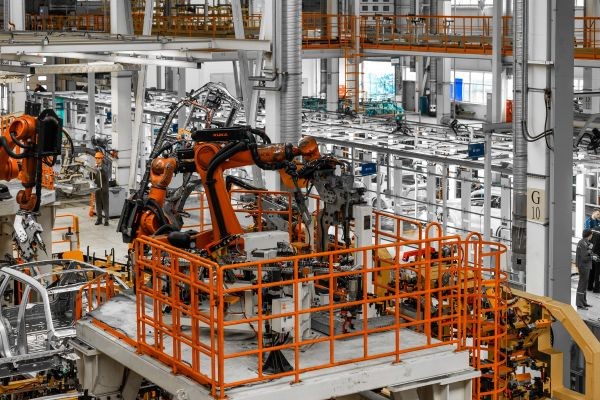
Across China’s industrial belt, the most noticeable change is the absence of people on the shop floor. Appliance makers, steel producers, and garment firms are retooling plants with:
Industrial robots that handle repetitive assembly tasks
Sensors and AI systems that monitor production in real time
“Dark factories” (fully automated plants with minimal human presence) like those operated by Baosteel
These technologies allow factories to run complex operations with less supervision, improving efficiency and reducing errors.
3. Scale of Adoption
China is now the world’s largest market for industrial robots, installing nearly 295,000 units in a single year. Domestic firms such as Estun Automation and SIASUN are leading the charge, developing AI-powered robotics tailored for small and medium enterprises.
4. Benefits of AI Integration
AI is not just about machines replacing humans—it’s about optimizing workflows:
Predictive maintenance reduces downtime
Smart scheduling balances production loads
Machine vision ensures quality control
Data-driven insights help companies adapt quickly to market changes
5. Challenges and Opportunities
While automation boosts productivity, it raises important questions:
Employment impact: What happens to displaced workers?
Reskilling needs: China must invest in training programs to prepare workers for higher-skilled roles.
Global competitiveness: Automation helps China maintain its edge, but rivals like South Korea, Japan, and Germany are also advancing rapidly.
6. The Bigger Picture
China’s push for automation is not just about economics—it’s about securing its position as a global manufacturing powerhouse in an era of geopolitical uncertainty. By embracing robotics and AI, China aims to offset rising costs, ensure efficiency, and remain indispensable to global supply chains.
Conclusion
Automation in Chinese factories is more than a technological upgrade—it’s a strategic transformation. Robots and AI are helping China adapt to labor shortages, rising wages, and global pressures, ensuring that its factories remain competitive in the decades ahead.